SPONSORED BY ROOFLE TECHNOLOGIES and OWENS CORNING
Digital tools are changing the metal roofing process rapidly. Are roofing contractors ready to keep pace?
By Central States Inc.
TECHNOLOGY
From Tape Measures to
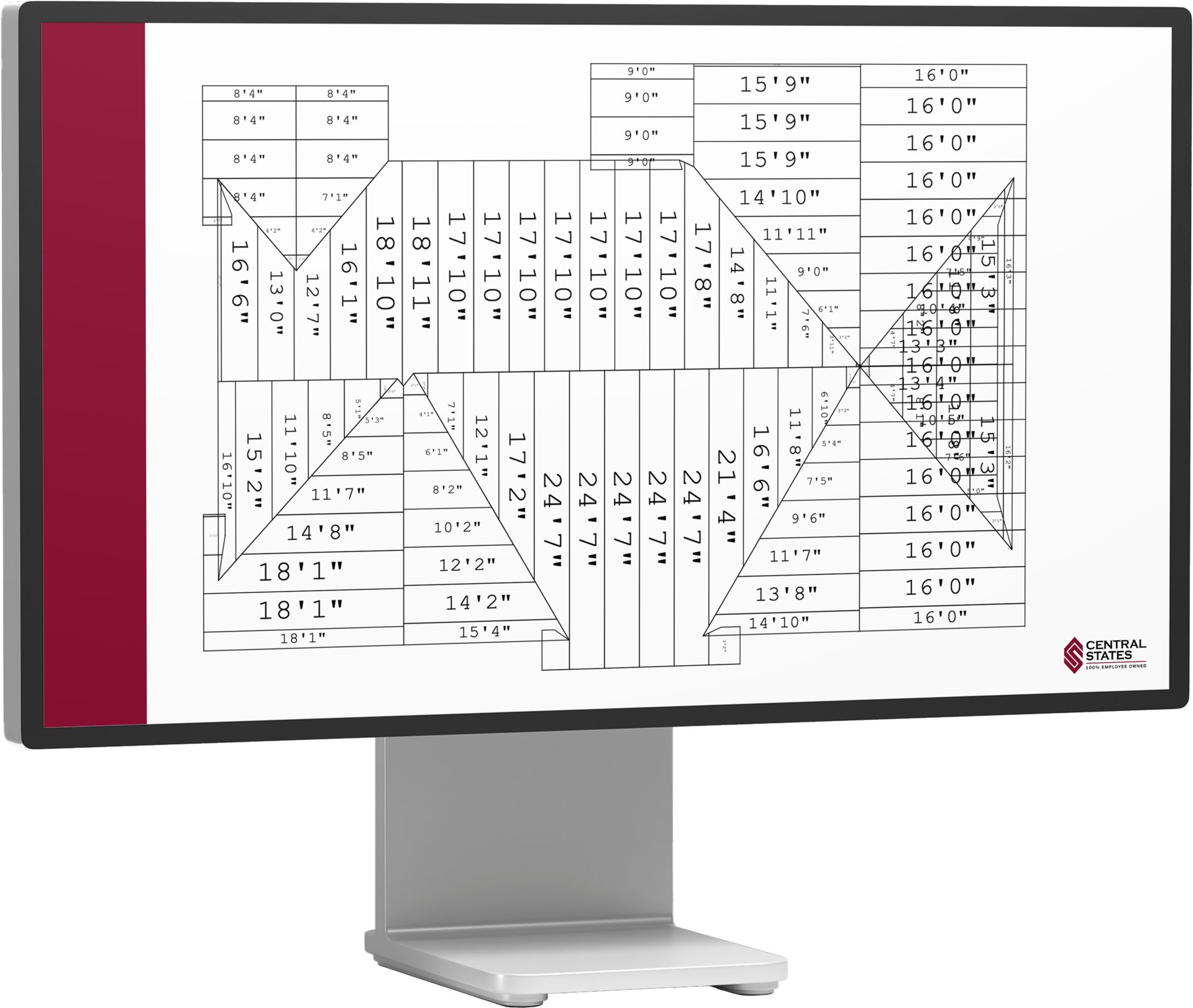
Roofing estimates are only as reliable as the measurements behind them.
Photo Credit: Central States
For decades, metal roofing takeoffs have been one of the most time-consuming and error-prone steps in the estimating process. Between complex roof geometry, multiple panel types, trim considerations, and waste calculations, even experienced estimators have had to rely on a combination of manual measurements, printed plans, and a fair amount of judgment.
Today, that process is changing rapidly. Advances in estimating software, aerial measurement apps, and AI-driven tools are giving contractors new ways to simplify takeoffs, improve accuracy, and ultimately bid more work with greater confidence. Perhaps just as importantly, they are dramatically reducing turnaround times in a highly competitive industry where the first bid returned often wins the job.
“As we’ve talked with contractors across the industry, the biggest challenge has consistently been turnaround time,” says Junny Lee, marketing manager at The Sherwin-Williams Company. “Roofing is hyper-competitive, and more often than not, the first bid returned wins the job.”
The Challenge of Metal Roof Takeoffs
Metal roofing systems introduce a level of complexity that goes beyond standard residential shingle jobs. Estimators must account for panel layouts, seam spacing, trim conditions, fastener systems, and material optimization often across irregular roof shapes. Unlike asphalt, which experienced reps can often estimate quickly in the field, metal roofing is a completely custom-fit substrate that has historically required days to quote accurately.
“With asphalt shingles, many experienced reps can get an estimate in the ballpark just by looking at a home,” Lee explains. “Metal is different. It’s a completely custom-fit system, and historically it’s taken days at a minimum to quote accurately.”
Traditional workflows compound that challenge. Manual measurements, whether taken from ladders, tape measures, or printed plans, are not only time-intensive but vulnerable to error. Even small inaccuracies in area, pitch, or linear dimensions can result in material shortages, overages, or reduced margins.
“Metal isn’t just complex because of surface area,” Lee adds. “It’s the precision required to minimize waste and protect margins that makes accurate takeoffs so critical.”
In a competitive bidding environment, those inefficiencies also limit a contractor’s ability to respond quickly. When estimating takes too long, metal roofing can become an afterthought in the sales process instead of a true alternative to asphalt.
“Advances in estimating software, aerial measurement apps, and AI-driven tools are giving contractors new ways to simplify takeoffs, improve accuracy, and ultimately bid more work with greater confidence.“
Weather Wild Card: El Niño 2026
The global phenomenon is expected to push temperatures higher during peak roofing season, creating potential opportunities for contractors at the ready.
One unknown factor that could influence the extreme weather forecast for North America—and just how busy roofing contractors will be this season—is the El Niño effect.
According to the National Oceanic and Atmospheric Administration (NOAA), experts predict a 60% chance of an El Niño weather pattern developing over North America by late summer and lasting through the end of the year. El Niño patterns create volatile weather when the jet stream is supported by heat coming from the subsurface ocean and the expected weakening of the low-level trade winds.
On average, El Niño seasons produce about 10 named storms and five hurricanes, compared to 15 storms and eight hurricanes during La Niña years. Neutral seasons average 13 named storms and seven hurricanes.
This season, forecasters said to:
- Expect increased disruptive wind shear and reduced storm activity, especially later in the season.
- A 15% possibility of a Super El Niño developing in the second half of the hurricane season, which could mean even less activity in the Atlantic. These are strong weather events spurred by above-average sea temperatures. They are rare, occurring only every 10–20 years, and bring long-lasting moisture that often leads to extreme heat and heavy flooding.
Stoking the predictions are facts such as that the West and Southwest regions of the country experienced their warmest winters on record, according to NOAA. The northeast Pacific reached its highest ever average temperature, about 69 degrees, in September, and marine heat waves continued through the winter and into the spring. In March, ocean waters along parts of the West Coast were roughly 3 to 4 degrees above normal, according to NOAA's latest sea surface temperature measurements.
Satellite data show sea surface temperatures rose sharply in April in the central and eastern Pacific.
To track it all, AccuWeather announced its weather data is now available through an app integrated into ChatGPT, a move that could affect how roofing contractors access forecasts on the jobsite.

Photo Credit: MCCAIG/iStock/Getty Images Plus via Getty Images
The Rise of Digital Takeoff Tools
Modern roofing technology is addressing these challenges by shifting takeoffs from manual processes to digital workflows. Instead of climbing roofs or tracing plans by hand, contractors can now generate measurements from aerial imagery, drone data, or uploaded drawings.
Platforms like Sherwin-Williams’ Roofing Passport are helping drive this shift by bringing together best-in-class data sources and simplifying how takeoffs are created.
“Roofing Passport has dramatically reduced the amount of time estimators spend creating takeoffs,” says Alison Donda, product owner at Sherwin-Williams. “Instead of waiting days, contractors can now quote much faster and confidently sell metal roofing alongside asphalt - not as an afterthought.”
By simply entering an address, contractors can generate highly accurate roof geometry through integration with aerial measurement providers like Eagleview. For new construction, plans and blueprints can be uploaded and processed through RoofingWRX.
“Sherwin-Williams has partnered with industry leaders to handle the most complex part generating geometry,” Lee notes. “By combining aerial measurement with blueprint processing, contractors can create accurate takeoffs from the comfort of their desk.”
These platforms calculate essential data points including square footage, pitch, ridges, valleys, and material quantities automatically. The result is a faster, more consistent process that reduces guesswork and allows estimators to focus on pricing and strategy rather than raw measurement.
Turning Digital Files Into Quotes and Orders
The real power of digital takeoff tools is the ability to turn accurate roof measurements into a detailed takeoff list for a specific roof system, with specific installation applications, for a specific manufacturer or preferred brand. Thanks to digital integrations and collaboration, manufacturers who have invested in technology to benefit their customers can take those detailed Roofing Passport parts lists as an upload into their systems, like Central States Manufacturing’s popular Central Link portal, and quickly turn them into quotes and orders, saving distributor reps and roofing contractors hours every day and offer quick quote turnaround for their customers.
“With asphalt shingles, many experienced reps can get an estimate in the ballpark just by looking at a home. Metal is different. It’s a completely custom-fit system, and historically it’s taken days at a minimum to quote accurately.“
Turning Digital Files Into Quotes and Orders
The real power of digital takeoff tools is the ability to turn accurate roof measurements into a detailed takeoff list for a specific roof system, with specific installation applications, for a specific manufacturer or preferred brand. Thanks to digital integrations and collaboration, manufacturers who have invested in technology to benefit their customers can take those detailed Roofing Passport parts lists as an upload into their systems, like Central States Manufacturing’s popular Central Link portal, and quickly turn them into quotes and orders, saving distributor reps and roofing contractors hours every day and offer quick quote turnaround for their customers.
Improving Accuracy and Protecting Margins
Accuracy remains the central benefit of digital takeoff tools. Roofing estimates are only as reliable as the measurements behind them, and even small discrepancies can lead to costly mistakes.
Digital measurement platforms reduce these risks by automating calculations and standardizing how roof geometry is measured. They account for pitch-adjusted area, complex shapes, and linear features more consistently than manual methods.
This precision is especially critical in metal roofing, where optimizing panel layouts and minimizing material waste directly affects margins.
“Technology like Roofing Passport helps contractors maintain their margins by improving precision and reducing material waste,” Brendan McGinnis, MetalVue program manager at Sherwin-Williams says. “That level of accuracy simply wasn’t achievable at scale with manual processes.”
A detailed takeoff report delivers value beyond basic measurements by translating roof geometry into actionable insights that guide panel layout, material planning, and installation efficiency. By mapping precise dimensions such as ridges, valleys, panel runs, and transitions, the report helps contractors visualize how panels will be placed across the roof, reducing guesswork and minimizing field adjustments. This level of detail supports optimized panel layouts that limit waste, improve material ordering accuracy, and streamline fabrication. It also gives crews clearer direction in the field, reducing install time and potential errors, while helping contractors better protect margins through more predictable, controlled execution.
As a result, contractors can order materials with greater confidence, minimize waste, and protect project margins—an increasingly important advantage as material costs fluctuate and competition intensifies.
Technology as a Competitive Advantage
As roofing contractors continue to navigate labor shortages, tight margins, and increasing customer expectations, the ability to produce fast, accurate estimates has become a key differentiator.
Looking ahead, the next phase of evolution will likely involve more integrated systems that connect estimating, ordering, manufacturing, and invoicing into a single workflow.
“The next step is an all-in-one system built specifically for contractors,” McGinnis says. “Something that allows them to follow a project from the initial sales call all the way through installation with confidence at every stage.”
Digital takeoff tools, aerial measurement apps, and digital ordering portals are no longer optional—they are quickly becoming essential components of a competitive roofing business. For metal roofing contractors in particular, these technologies offer a way to simplify complex takeoffs, reduce risk, and position their teams to take on more work without sacrificing accuracy.
“Contractors should be paying attention to solutions that bring real value, fit into their workflow, and meet them where they are,” Lee adds. “That’s where the industry is headed.”
Art Aisner is editor-in-chief of Roofing Contractor. Reach him at 248-244-6497 or aisnera@bnpmedia.com.
Chris Gray is editor of Roofing Contractor. Reach him at 248-244-6498 or grayc@bnpmedia.com.