GUEST
COLUMN
Rob
HADDOCK
Photo Credit: National Gypsum Company
SCROLL
DOWN
Danaik Garay of AlSteel Roofing in Fort Myers, Fla., and Diana Barriga of Property Master Solutions in Orlando, Fla., are two NWIR members who are leading the Hispanic Connection Council initiative.
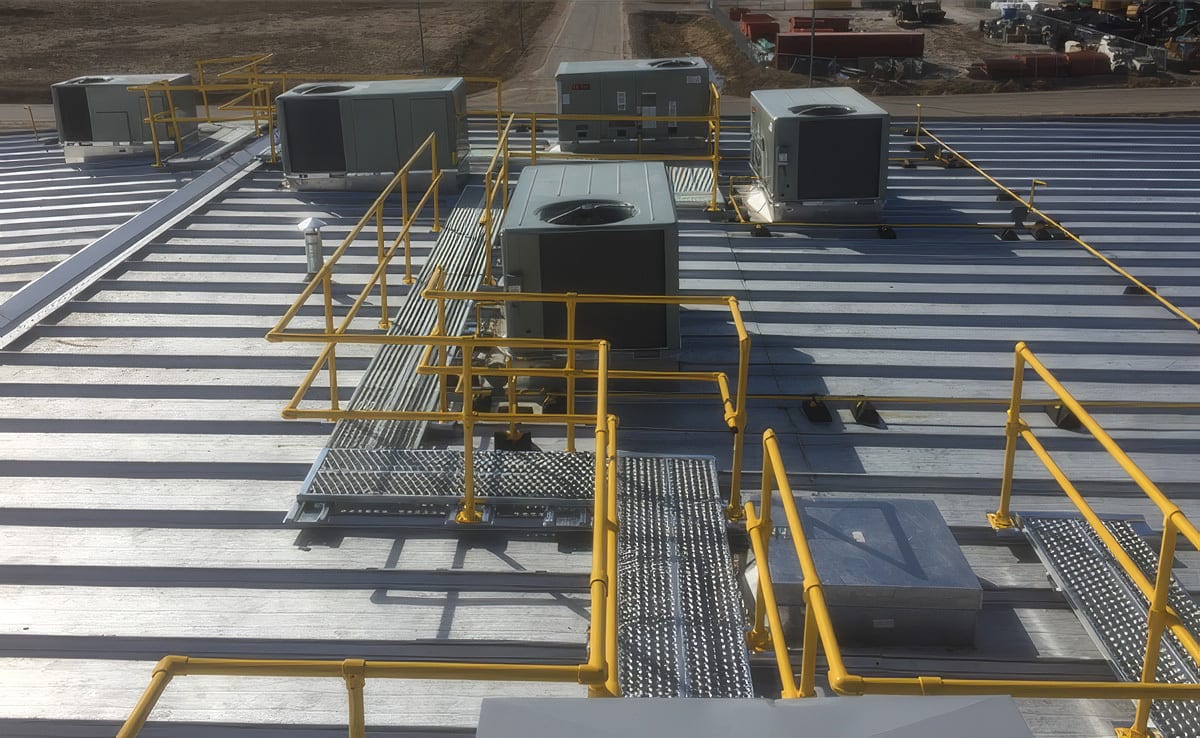
Rooftop service walkway mounted with S-5! clamps.
Photo credit: S-5!
Understanding Fall Protection—and the Unique Role Metal Roofs Play
Learn why fall protection is essential on metal roofs and how OSHA-compliant systems help prevent serious worker injuries and fatalities.
Falls from roofs continue to be a leading cause of serious and fatal injuries in construction. Workers are frequently exposed to significant rooftop hazards, particularly when fall protection is inadequate or improperly implemented. Although the Occupational Safety and Health Administration (OSHA) sets clear safety standards, violations remain widespread, often driven by lack of awareness, poor planning, or disregard for proper safety procedures.
According to the most recent data from the Census of Fatal Occupational Injuries (2021) Bureau of Labor OSHA Statistics program, fatal work injuries recorded in the United States increased by 8.9 percent in 2021 from the previous year, and falls remain the leading cause of work-related deaths in construction.
Global safety cultures
In the U.S., it is the responsibility of the employer to protect the employee from rooftop hazards, and because job site visits are infrequent and temporary, most employers choose devices that are temporary and portable. In most other places throughout the world, this is not the case. It is the responsibility, rather, of the building owner to provide the means of protection. For this reason, fall protection systems tend to be permanently installed throughout the building’s life. In the U.S., we are beginning to see a trend toward the latter practice.
Why Wind Ratings Still Matter on the Jobsite
Despite their limitations, impact and wind ratings play an essential role. For contractors, the value is not the number itself but knowing how to use it properly. Ratings provide:
- Objective, third-party performance baselines
- A pathway to code compliance and permitting
- Guidance for insurance underwriting and incentives
- Reduced risk of catastrophic roof failure when applied correctly.
So, how do metal roofs play into the equation?
Although metal roofs are known for their durability, sustainability and versatility, they can be quite slippery, posing a potential fall hazard, leading to serious injury for workers and liability for a business. Add inclement weather like rain or snow, and the risk is elevated for any worker needing roof access.
Whether installing rooftop equipment, accessories such as HVAC, service walkways, solar PV and snow retention, or conducting rooftop inspections, cleaning, maintenance or servicing equipment, rooftop access is necessary year-round. Fall protection ensures safety on that roof.
Many contractors and installers spend hours on metal rooftops and are confident they can easily navigate the terrain. But accidents happen, so a reliable fall protection system is a must. In addition to protecting the company and its employees, OSHA has established a number of requirements professionals must follow so it’s important to select a fall protection system that complies with OSHA regulations.
“Metal roofs are built to last—but without proper fall protection, a single misstep can have life-changing consequences.”
Main types of fall protection
According to OSHA, fall-arrest systems must be designed to prevent a worker from free falling more than six feet or contacting a lower level, such as the ground or a lower roof plane. In many cases, this requires guardrails or personal fall-arrest systems, which include anchors as secure attachments for the system.
- Anchor Points
An anchor point can be a single secure attachment used as a fall-arrest system. In this situation, a body harness is connected to the anchor, limiting the falling distance if a worker was to descend over the edge. Anchor points may incorporate one or multiple attachments and can also be paired with travel-restraint lanyards designed to prevent access to the area where a fall hazard occurs.
Another option providing more freedom of movement is called a horizontal lifeline. This system includes multiple anchor points and a connection cable. The anchor points can be installed on a temporary or permanent basis and require some training for proper use.
For fall-arrest systems, OSHA requires the anchorage strength to either be “capable of supporting at least 5,000 pounds per person attached or designed, installed and used under the supervision of a qualified person, as part of a complete personal fall arrest system that maintains a safety factor of at least two.”
Fall-restraint (or travel-restraint) systems must be able to “withstand 3,000 pounds or twice the maximum expected force needed to keep the worker from accessing the fall-hazard area.” - Guardrails
Guardrails are placed around the roof’s perimeter or any unprotected or exposed side to prevent falling off the edge. As passive barriers, guardrails do not require training. When correctly installed, they are extremely reliable. Often permanent fixtures on the roof, guardrails can save money on repeated professional inspections.
Guardrails used for fall protection must be able to withstand a 200-pound force in any outward or downward direction within two inches of the top rail extremity. - Walkways
In large commercial settings, rooftop walkways are another way to keep workers safe when there is equipment or systems on the roof that must be maintained. For example, on the Apple Park headquarters building in California, six miles of walkways were installed in conjunction with a 7.4 MW rooftop solar PV array.
Determining if the fall protection is truly secure
Given the weight loads the systems need to carry, it is critical to ensure that the rooftop attachments can support the anchors, guardrails or walkways in a safe and reliable manner. The only way to ensure this reliability is to utilize attachments properly load tested, including a factor of safety. Then, engineer the fall protection system using the tested design load information.
The variables involved in metal roofing include profile types, material types, gauges and substrates.
Load testing must take into account all of these factors to be viable. Each situation is unique, and the way an attachment performs on one type of roof is no guarantee it will perform the same way on another. For this reason, it is important to consult attachment load tests that have been performed for the specific roof type and profile. In addition, these tests should be certified through an independent third party, to ensure the results are proven accurate.
Once the exact values are determined, the system can be engineered to withstand the appropriate loads designated by OSHA.
When mounting fall protection, be careful not to compromise the integrity of the metal roof. For a standing seam metal roof, select clamps that are specifically made to fit the seam profile. Source clamps that are produced in an audited facility with quality assurance standards for product consistency. Make sure the clamps are manufactured from corrosion-resistant metals and are metallurgically compatible with the roof material. Additionally, it’s critical to know the reputation of the manufacturer to ensure the system is verified and has been accurately engineered and tested for the loads it must withstand on the specific roof profile.
Choose non-penetrating clamps that rely on a mechanical interlock for superior holding strength while protecting the metal roof from unnecessary holes. For permanent fall protection systems, source clamps that have the durability to last the life of the roof, backed by the manufacturer’s warranty.
“Any roof that requires regular access also requires a plan to keep workers safe while they're there.”
Main Takeaway
It’s critical to protect workers from falling off a metal roof – whether installing ancillaries and equipment or conducting inspections and maintenance. OSHA regulations offer multiple fall-protection strategies to choose from, including anchor points, guardrails, and walkways.
To ensure safety measures provide adequate protection and meet OSHA-identified loads, utilize rooftop clamps that are:
- Independently load tested to the specific project parameters.
- Designed to fit the seam profile of the standing seam roof.
- Manufactured in a facility with independent quality assurances.
- Non-penetrating, to protect the roof.
- Corrosion-resistant and long-lasting.
By selecting tested and proven attachment solutions, fall protection systems can be engineered to keep workers safe and truly confident on the roof.
A Message for Roofing Leaders
Roofing is still a relationship business. As a roofing company, you’re not just building roofs but building relationships. And relationships are built on communication. People let you on their homes/offices, which are their most valuable assets. If they don’t trust you to communicate, they will not trust you to build.
So, forward-thinking roofing contractors are looking beyond nails and shingles. They are investing in customer experience, and SMS is the easiest and most effective place to start.
The strength of your roofing business does not lie just in how well you install, but it lies in how well you communicate.
As the roofing industry is constantly evolving, roofing contractors using modern communication tools like SMS will stand taller than those without. In short, in a roofing business, every lead counts, and every appointment matters. Therefore, texting is not just a luxury; it is a necessity. It keeps your jobs on track, your customers informed, and your business growing.
*Based on testing conducted by a third party in 2017 using UltraPly™ TPO SA versus standard adhered TPO. Application times vary with settings and environmental factors; actual results will vary.
**ISOGARD polyiso insulation performed up to 40% better in cold temperature 40°F (4°C) applications according to ASTM C1289 standards than major competitors when tested by an independent third party in September 2022. The increased R-value per inch indicates better thermal performance in cold temperature 40°F (4°C) from the same roofing systems using the same amount of insulation compared to leading competitive products on the market today. Results may vary.
Rob Haddock is the CEO and founder of S-5! and the inventor of metal roof attachment solutions. A former contractor turned building-envelope scientist, Haddock has dedicated more than five decades to advancing the metal roofing industry. For more information, visit www.S-5.com.